
Beyond Human Scale
Doxiadis reflected on the coexistence of people and machines. Today, the city itself is increasingly conceived as one.
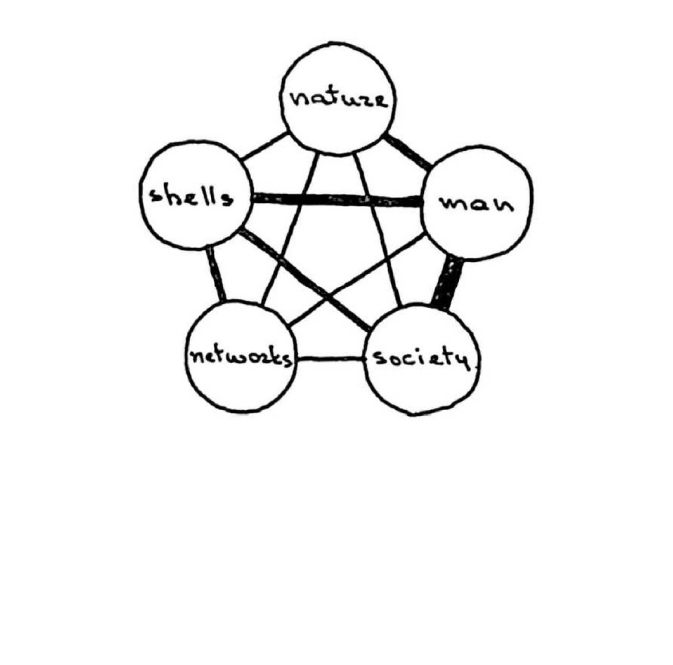
The five elements of human settlements and their interdependence. Constantinos A. Doxiadis, Between Dystopia and Utopia, 1966, fig. 13.
In Between Dystopia and Utopia, Constantinos Doxiadis examined how the modern city was being transformed as human scale gradually receded. Cities, he argued, had developed in relation to the human body, its senses and its desires. The arrival of the machine altered that relationship. He wrote: “Now man is forced to accept his cohabitation with the machine, disputing the same space with it, breathing its exhausts.”
Nearly sixty years later, this cohabitation has acquired another dimension. The machine has expanded from an object moving through the city into the system through which the city is conceived and operated. We are beginning to imagine urban environments in which human beings may effectively live inside the machine.
Technological progress has greatly expanded human possibility. Its achievements are undeniable. The question concerns the environments it produces and the conception of human life embedded within them.
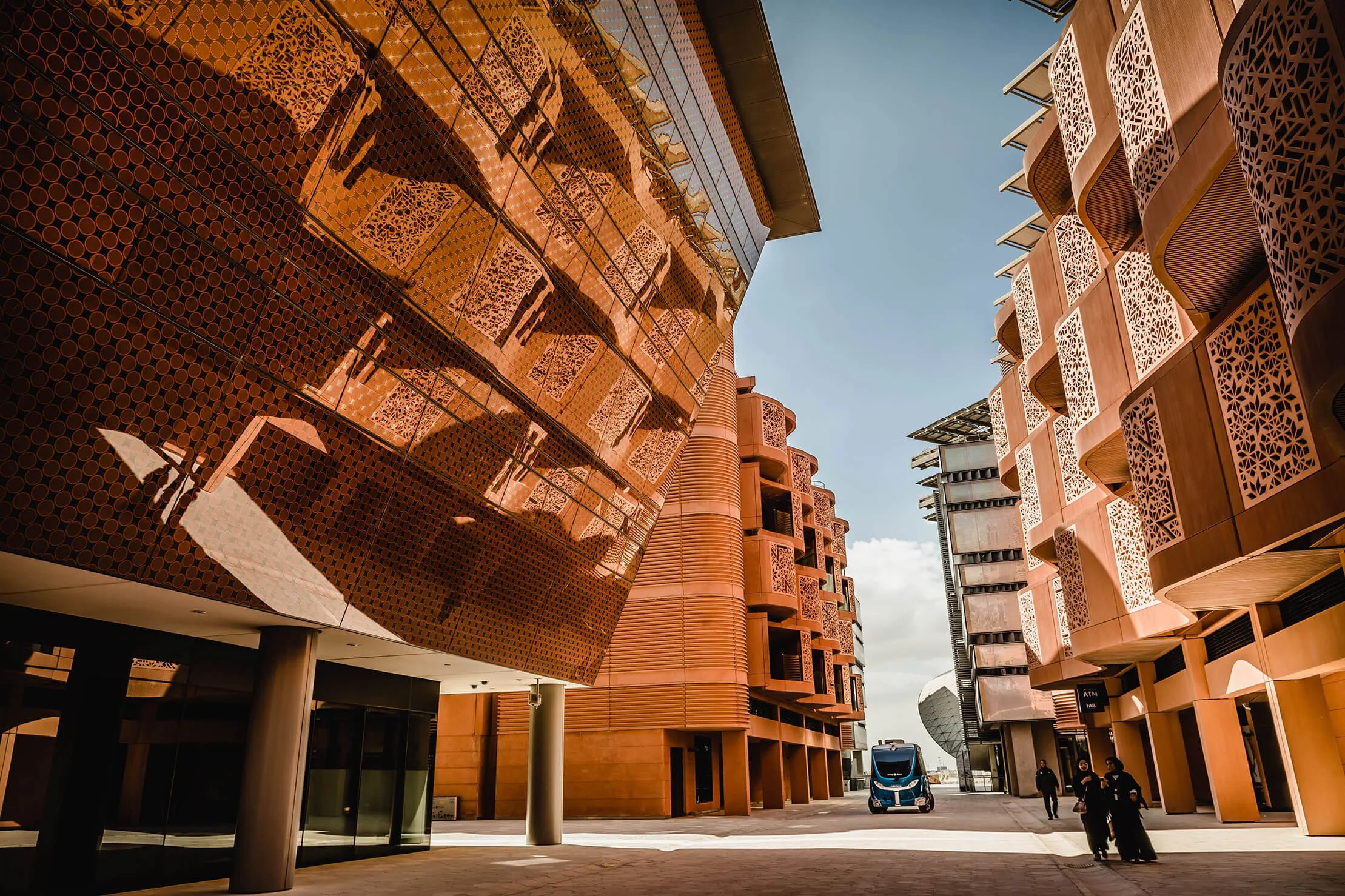
Masdar City, Abu Dhabi. Image source: Masdar City Media Gallery. © Masdar City. masdarcity.ae/news-and-media
Masdar City offers a built example of this changing relationship. Conceived as a zero-carbon, zero-waste and car-free city in the desert climate of Abu Dhabi, its original programme was gradually recalibrated as its ambitions encountered economic, technical and practical realities. This adjustment may be one of its most valuable lessons. Its most persuasive qualities remain spatial and physical: shaded streets, short distances and buildings formed in response to heat. Here, technology supports the body and strengthens its relationship with its surroundings.
The Line extends this ambition to an unprecedented scale. Conceived as a city contained within a linear structure 170 kilometres long, it promises that everyday needs will remain within walking distance while rapid transport connects its entire length. Proximity here depends on an immense technical apparatus. The city becomes a single, continuously managed structure: a building, an infrastructure and a machine at the same time.
The same logic becomes clearer as urbanisation moves into environments hostile to human life. OCEANIX Busan proposes floating platforms: where humans cannot inhabit the sea, architecture manufactures an island. Settlements on the Moon or Mars would extend this principle further: where humans cannot survive, architecture would have to manufacture the conditions of Earth. In both cases, the city becomes a life-support system between the body and its environment.
Once technology becomes responsible for reproducing the conditions of life, the same ambition can turn towards the body itself. Doxiadis described people as gradually becoming centaurs—half human, half car—a metaphor for a body joined to the machine that extended its movement. Transhumanism carries this relationship further by imagining the technical enhancement of the body. Human scale begins to shift: the body ceases to be the measure and appears as a limitation that technology may eventually overcome.
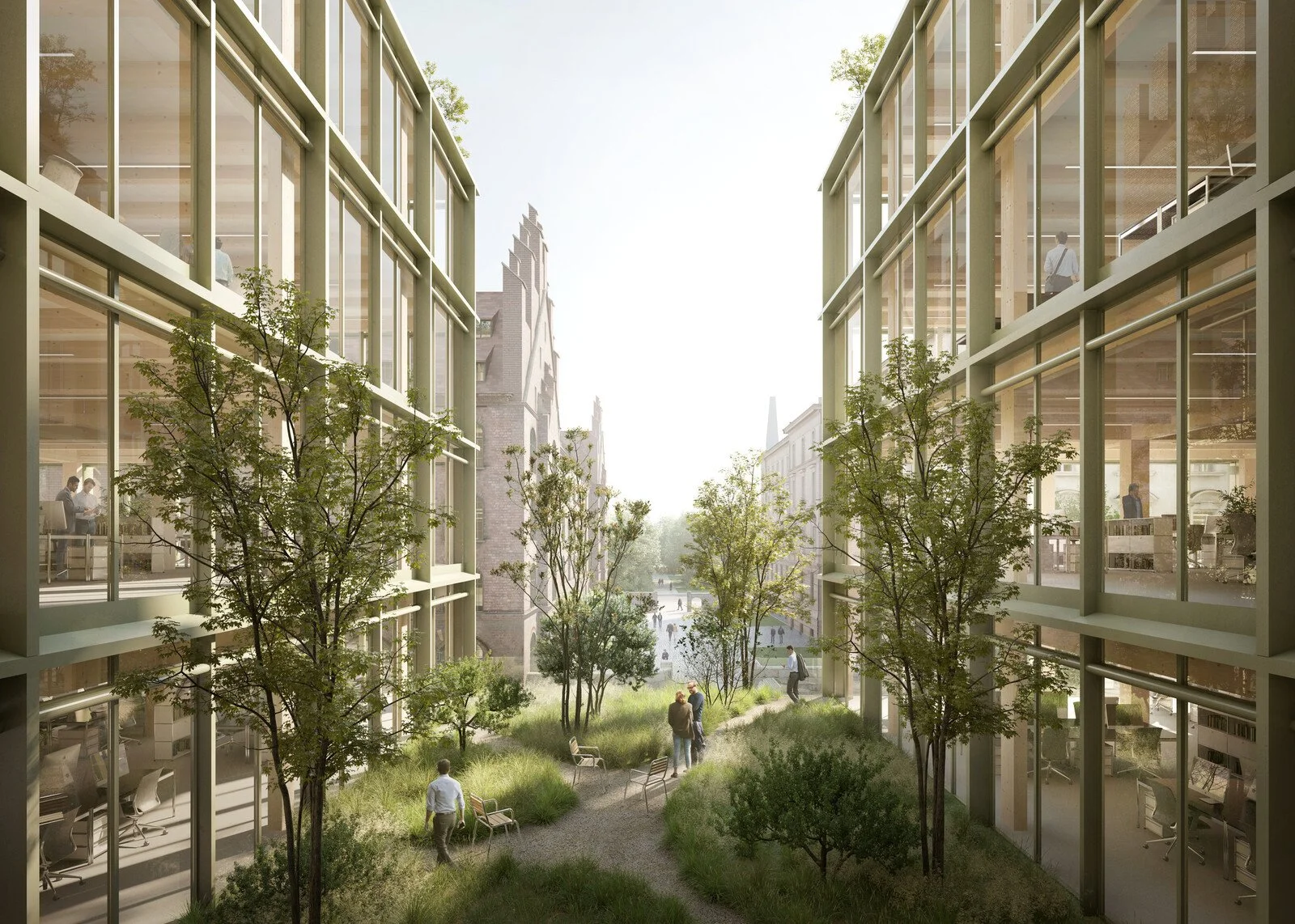
Development Schützenstraße, Munich, 2022. David Chipperfield Architects Berlin. Visualisation © Filippo Bolognese Images.
davidchipperfield.com/projects/development-schuetzenstrasse
Human nature and the natural world have always formed a dynamic relationship. Through it, humanity has gradually created its own environment. The terms of that relationship were once more visible, allowing limits and consequences to be understood more directly. Today, every intervention enters a far more complex network of technological and ecological dependencies.
Within this complexity, the meaning of wellbeing may become confused with the capacity to overcome every limit. Eu-topia must be reconsidered as a balanced relationship between human nature, the natural world and the environments we create. That balance must be conceived within contemporary technological reality. Before imagining how human beings might adapt to future cities, architecture must ask whether those cities remain worthy of human life.